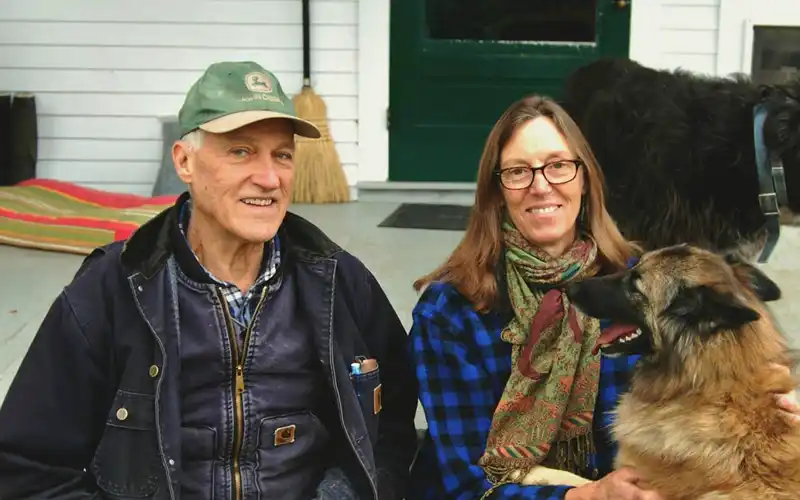
Some people live quietly, yet their work leaves a lasting mark on the places and the art around them. Suki Fredericks is one of them. She is a paintings conservator in Vermont, a former organic dairy farmer, and the mother of Cooke Maroney. Many readers first hear her name because of her son’s fame. Her own story is far richer than a footnote in a celebrity profile.
This article follows her path step by step. You will read about her training in art care, the big move from New York City to the Green Mountain State, the years on a busy organic farm, and the family life that grew there. You will also see how the farm looks today and why the family prefers to stay out of the headlines.
A Quick Look at Her Life
She is a woman of two trades. In her studio she cares for old paintings. Outside it she has spent decades caring for open land, animals, and gardens. Home is a hilltop farmhouse in Vermont, shared with her husband James Maroney.
Each part of that life gets its own section below, starting with the work that has filled her career.
Her Work as an Art Conservator
Most people picture an art restorer as someone who paints over damage. A conservator does something more careful. The goal is to protect a work and keep as much of the original as possible, so every step must be gentle and thoughtful.
She has worked in this field since 1976, both for private clients and for museums. Her training came from New York University’s Institute of Fine Arts, where she earned a master’s degree in Art History and a certificate in conservation. That mix of history and hands-on skill is what lets a conservator understand why a painting looks the way it does before touching it.
Her business is called Oliver Hill Paintings Conservation, and it runs from the farm. The studio handles the kind of problems that old canvases often have. These include flaking paint that needs to be secured, tears in the canvas, worn edges that need a new strip of support, surface grime, and old varnish that has turned yellow or cloudy. She also carries out collection surveys, where a conservator walks through an entire collection and records which pieces need help first.
Her clients include well-known Vermont institutions. The Shelburne Museum has relied on her skills, as has the Marsh-Billings-Rockefeller National Historical Park. She has also helped Curtains Without Borders, a project that works to save historic theater curtains. She is a Professional Associate of the American Institute for Conservation, which shows that her work meets the standards of her profession.
Her interests extend beyond the studio. She joined four other contributors in the Henry Sheldon Museum of Vermont History’s “Five-Point Perspective” project, where each person chose items from the collection to highlight. Their picks ranged from dolls and fabrics to eyeglasses, a sculpted dog, and a life-size horse.
Why They Moved to Vermont
Her Vermont story began in 1986. At that time, she and her husband were living in Manhattan, near Park Avenue and 74th Street. Both wanted a different kind of life. James has explained that they believed in the pastoral ideal and wanted to raise their family on a farm instead of in the middle of a crowded city. Their son Cooke was only about two years old.
The property they bought in Leicester had been run by a corporation that called it Agrivalley. The couple gave it a new name, Oliver Hill Farm, as a tribute to its original founders, two bachelor brothers who were both named Oliver.
Leaving a high-powered city was not a small decision. It meant a new community, a new routine, and a new set of skills. It also gave both of them room to build work that mattered to them.
Building an Organic Dairy
The farm did not stay quiet for long. In 1990, Oliver Hill Farm became the third certified organic dairy in Vermont. By many accounts it was also the biggest. At its busiest, the farm milked around 125 cows and employed about six farmhands. The herd produced roughly two million pounds of organic milk every year.
It is easy to forget how unusual this was. Organic milk was almost unknown at the time, and James has said that many people had never even heard of it. Running a large organic dairy meant following strict rules, long before shoppers started looking for those labels.
She was deeply involved in the daily work. Her tasks covered the farm’s office duties, the care of the fields, a large vegetable garden, and livestock. Her paintings practice ran alongside all of this. The farm also supplied local co-ops with organic produce and eggs.
Family life had a rhythm of its own in those early years. James spent his first decade in Vermont splitting his time between the farm and Manhattan. She and young Cooke sometimes traveled with him. After Cooke started kindergarten and a daughter, Annabelle, was born, she and the children stayed in Vermont for most of the year.
What Happened After the Fire
In the mid-1990s, a fire destroyed the farm’s main milking barn. Neighbors helped by taking in some of the animals for a while, but the damage was too great for the dairy business to continue. The couple sold their herd and stepped away from milking.
Many families would have left after such a blow. They chose to stay and looked for new ways to use the land.
One important step was a partnership with the Vermont Land Trust. A land trust is a non-profit group that helps landowners protect open land from being built over. Thanks to this agreement, more than half of the property is now conserved for farming. She has said she wanted the farm to stay farmland for as long as possible. As of 2015, the full acreage had been certified organic for 24 years.
The fields have not gone to waste. Neighboring farmers use them for pasture and feed, and she works with those neighbors to manage them. An organic beef operation called Mountain Meadow Farm keeps its cows in the old heifer barn, and its beef has earned a strong rating from Whole Foods.
She has also taken part in local debates. When a natural gas pipeline was proposed that could have crossed the property, she joined the conversation about its effects on the land and the community.
Life With James Maroney
The story of James Maroney and Suki Fredericks is partly a story of two careers that crossed in an unexpected place. He began as an art dealer in Manhattan. After the move he became a dairy farmer, and later a voice on farming policy.
His views are clear. He believes Vermont should ban herbicides, pesticides, artificial fertilizer, and drugs for farm animals, and he thinks that such a step would end the future of non-organic milk in the state. He wrote a book on the subject called 5 Solutions to Vermont’s Farm Crisis: The Omnivore’s Fundamental Dilemma. He has also spoken at local farm meetings, in newspapers, and at hearings in the Vermont legislature, including one in 2009–2010 on the future of the state’s farms.
Seen together, the pair make an interesting match. One partner spends her working hours on delicate surfaces, tiny repairs, and long-term care. The other spends his on big arguments about land, food, and public policy. What links them is a shared belief in looking after things so they last. For her it is a painting. For him it is a farm and the way a state feeds itself.
Raising Cooke and Annabelle
Cooke was born in 1984, and Annabelle came a few years later. Growing up on a working farm meant early lessons in hard work and sustainable living. Chores, animals, and open fields were part of everyday life in a way that city children rarely experience.
When the time came for college, Cooke went to New York University, the same school where his mother had trained. He later built a career in the art world and now works as an art gallery director. It is easy to see the link between his job and the home he grew up in, where art was part of the family story from the start.
The bond between Cooke Maroney and Suki Fredericks is often described as close, though the family shares very little about private moments. Annabelle has stayed even further from public view, and little is known about her life as an adult.
A Private Family
Public attention has grown since 2019, when Cooke married actress Jennifer Lawrence. Reporters began looking into his background and soon found the farm in Vermont. When one outlet called his mother for a comment on the engagement news, she thanked the caller and said she had nothing to say.
That reply suits the family well. They have given a few interviews about farming and conservation, but they avoid talking about their personal lives. Almost everything the public knows comes from local Vermont stories and a 2015 profile of the farm, not from the family sharing details about themselves.
Visiting the Farm Today
The farm is quiet now, but it is far from empty. Guests can stay in a guest house on the property. The cottage has three bedrooms and one bathroom, and it sleeps five people. Its windows look toward the Adirondack and Green Mountain ranges.
Breakfast is self-serve and built around local food. Visitors often find organic free-range eggs, homemade granola, yogurt, milk, bread, cider, and apples waiting in the fridge, and she is known for stocking it herself. Past guests describe her as a warm and welcoming host.
The farm is also known as a wedding venue. Couples who want a countryside setting can hold their celebrations on land with a long and interesting past.
Final Thoughts
Some stories do not need a spotlight to be worth telling. This one is about patience, steady work, and a family that built a life away from the noise.
Frequently Asked Questions
1. How big is Oliver Hill Farm?
Most sources say about 750 acres. A few give 775, so “around 750 acres” is the safest wording.
2. What does “certified organic dairy” mean?
It means the animals are fed organic feed grown without synthetic pesticides, they have access to pasture, and the farm follows strict limits on routine antibiotics and added hormones. Independent inspectors check these rules every year.
3. How can I protect an old painting at home?
Keep it away from direct sunlight, heat, and damp walls. Never clean it with household products or a wet cloth. If you see flaking paint or tears, stop handling it and ask a conservator for advice.
4. How do I find a paintings conservator in Vermont?
The Preservation Trust of Vermont publishes a restoration directory that includes her studio. The American Institute for Conservation also has a “Find a Conservator” tool for locating professionals in any state.
5. Why is Cooke’s name sometimes written as “Cook”?
Some early articles, including a 2015 farm profile, dropped the final “e.” The correct spelling is Cooke.
6. Why do some websites give different dates for the farm’s history?
The family has shared few details, so many sites copy and mix older reports. The farm was bought in 1986, became an organic dairy in 1990, and lost its barn in the mid-1990s, though some pages say 1994 and others say 1995.
7. What is the Marsh-Billings-Rockefeller National Historical Park?
It is a national park site in Woodstock, Vermont, and the only one in the state. It focuses on the history of land care and conservation, which makes it a natural partner for someone who spent her career protecting both art and farmland.